GCaptain Articles
Green Shipping
Revolutionary Wind-Powered Car Carrier Enters Critical Testing Phase
Hellenic News Articles
Shipping Technology
Maritime Travel
Global Ports
Green Fuels
Chinese Shipbuilding
U.S. Ag Trade
Global Trade
Green Shipping

GCaptain Articles
Green Shipping
Revolutionary Wind-Powered Car Carrier Enters Critical Testing Phase
Hellenic News Articles
Shipping Technology
Maritime Travel
Global Ports
Green Fuels
Chinese Shipbuilding
U.S. Ag Trade
Global Trade
Green Shipping

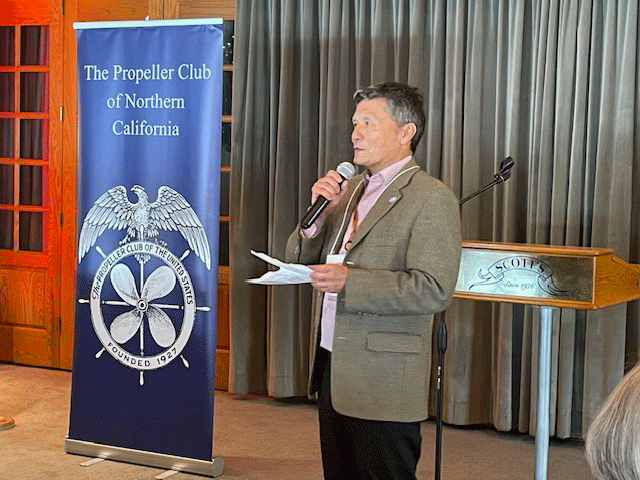
Thanks to $322 million in federal grants for zero-emission equipment and nearly $100 million for Port infrastructure, Port of Oakland Executive Director Danny Wan says the Port is: “doing a whole lot of work in putting the basic building blocks (for) a very successful, bright future for the Port of Oakland.”
Wan and Maritime Director Bryan Brandes provided their 2024 Annual Review to the Propeller Club of Northern California on December 3rd, 2024.
Wan thanked Port of Oakland maritime stakeholders, including truckers, shippers, terminal operators, and longshore workers represented by the International Longshore and Warehouse Union (ILWU): “We have a partnership with you, and we are making great strides … in our infrastructure that is being set in place …under the great leadership of our Maritime Director, Bryan Brandes. We are focused on making sure that the Seaport does what it’s supposed to do … that is making it … easy to get in and get out and … transparent in terms of where you are in terms of every step of the way. We are putting technology in to make sure … that’s what we’re doing.”
The big news, Wan said is: “The big news this year is our big success, again with the partnership, (of) many of you in this room … to make sure that the Port can get its fair share of … infrastructure money because we know that we need lots of infrastructure work. We are very proud and very happy that we got the $322 million of federal grants for … zero-emission equipment set in place. We also got close to about a hundred million dollars … got $50 million added to some previous grants for port improvement and port infrastructure development … to improve our wharves and to strengthen our wharves… I know that SSA is seeing some of that work and TraPac.”
In October, the Port of Oakland’s container volume rose 10% over recorded volumes for the same period in 2023. Loaded imports grew for the 12th straight month. Import volume rose 11.2% in October 2024, compared to October 2023. Port operators processed 81,498 TEUs (twenty-foot containers) versus 73,281 TEUs in 2023.
“Overall, the Port’s loaded import cargo is trending towards its pre-pandemic level,” said Port of Oakland Maritime Director Bryan Brandes. “This steady increase in import volume in 2024 is an encouraging trend. We are also seeing a rise in U.S. agricultural exports through Oakland. Thanks to refrigerated warehousing on Port property near the maritime terminals and convenient truck and rail access, we are well-positioned to continue to grow ag export cargo volume through the Oakland Seaport.”
GCaptain Articles
U.S. Maritime
M/V ARC Endeavor Joins Maritime Security Program Fleet
Global Trade
UNCTAD: Global Trade On Track to Hit Record $33 Trillion in 2024
Green Shipping
LNG’s Adolescence: Maturing Fast in the Race to Decarbonize Shipping, But Infrastructure Gap Looms
U.S. Shipbuilding
GAO Sounds Alarm on Navy’s Amphibious Fleet Readiness
Hellenic News Articles
Global Ports
U.S. Maritime
South Korean Shipbuilding
U.S. Ag Trade
Green Shipping
Maritime Regulations
Shipping Technology
GCaptain Articles
Shipping Technology
MAN Energy Solutions Achieves Full-Scale Ammonia Engine Testing Milestone
Global Trade
Maersk Sell Ratings Stack Up as Oversupply Concerns Mount
Hellenic News Articles
Global Ports
U.S. Ag Trade
Maritime Regulations
Maritime Industry
Maritime Training
Global Trade
Global Shipbuilding
GCaptain Articles
U.S. Port News
ILA-USMX Port Automation Dispute Intensifies as January Deadline Looms
U.S. Navy Operations
U.S. Navy Increasingly Turning to Commercial Tankers for At-Sea Refueling Operations
Global Trade
Global Supply Chain Leaders Grapple with Rising Tariffs, Survey Reveals
U.S.-China Tensions
China Bans Export of Key Minerals to U.S. as Trade Frictions Escalate
U.S. Offshore Wind
Biden Administration Forges Ahead with Offshore Wind Development Despite Trump Threats
Hellenic News Articles
South Korean Shipbuilding
Global Trade
U.S. Ag Trade
Global Ports
Global Shipbuilding
Shipping Technology
GCaptain Articles
Global Shipbuilding
India and Italy In Talks On Blue Economy, Port Cooperation
Panama Canal
BOEM Completes Environmental Review for Massive SouthCoast Wind Project as Trump Threat Looms
Panama Canal
Threatened by Climate Change, Panama Canal Has Big Plans to Deal With Drought
Global Trade
Hapag-Lloyd Expects Lower Profitability in Fourth Quarter
Hellenic News Articles
Global Ports
Chinese Shipbuilding
U.S. Ag Trade
Green Fuels
Global Trade
GCaptain Articles
Global Ports
Hamburg’s Historic Port Looks to the Future with MSC Backing
Global Shipbuilding
Hapag-Lloyd Secures Green Methanol Supply for Retrofitted Containerships
U.S. Shipbuilding
Coast Guard Inks Deal to Acquire ‘Aiviq’ As Vessel Arrives in Tampa Dry Dock to Begin Conversion
Hellenic News Articles
Global Ports
U.S. Port News
South Korean Shipbuilding
Global Ag Trade
Global Trade
Chinese Shipbuilding
Global Shipbuilding
Hellenic News Articles
Maritime Welfare
Maritime Collaborations
South Korean Shipbuilding
U.S. Ag Trade
Green Fuels
Green Shipping
Global Shipbuilding
Decarbonization
GCaptain Articles
U.S. Trade
Trump’s Trade War Redux: Meet the New Architect of America’s Tariff Agenda
U.S. Navy
Trump Nominates Financier John Phelan as Navy Secretary
Hellenic News Articles
Port Technology
Global Ports
Global Shipbuilding
U.S. Ag Trade
Decarbonization
Maritime Manpower
GCaptain Articles
Global Ports
Mexico Looks Past Trump Threats With $2.7 Billion Port Expansion
U.S. Trade
Trade War 2.0? Trump Announces Tariffs on Top Trading Partners
U.S. Trade Partners Warn Trump Tariffs Would Harm All Involved
Panama Canal
Panama Land Bridge: Can It Solve the Canal’s Drought Woes?
Suez Canal
Containership Transits of Suez Canal Hit 2024 High, But Big Ships Avoid the Route
Green Shipping
Faltering US Offshore Wind Industry Sends Next-Generation Startup Overseas
Global Shipbuilding
Austal Tapped to Build Australia’s New Heavy Landing Craft
U.S. Offshore Wind
Faltering US Offshore Wind Industry Sends Next-Generation Startup Overseas
Hellenic News Articles
Port of Rotterdam
Global Ports
South Korean Shipbuilding
U.S. Trade
U.S. Ag Trade
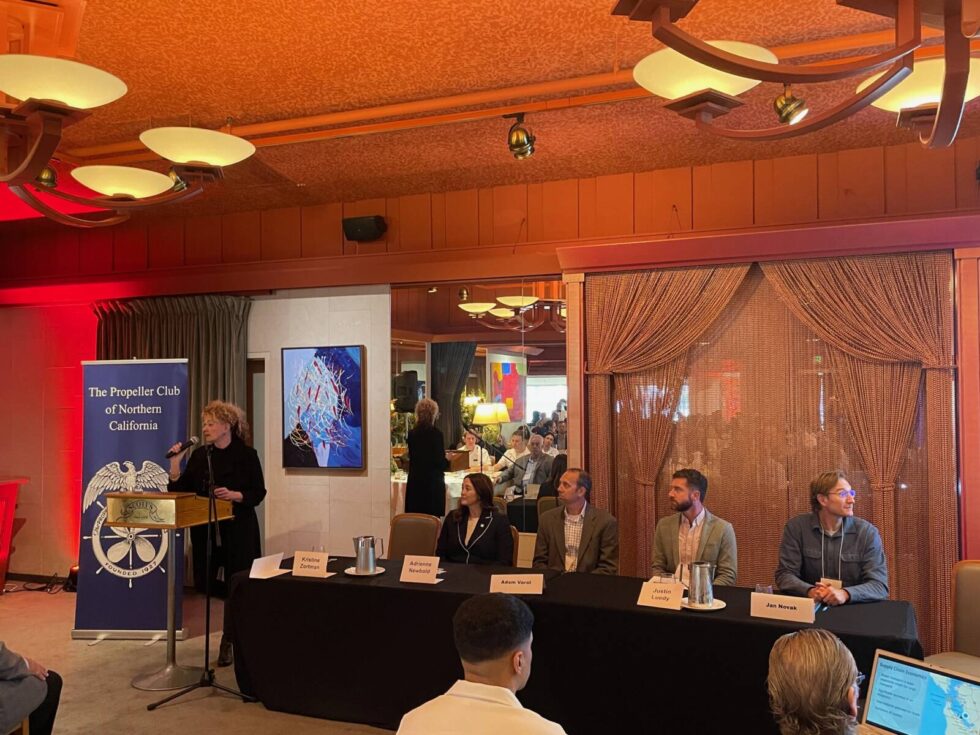
California ports are defensing against increased flooding and sea level rise to enhance future maritime operability. The ports discussed their plans at the “Storms, Flooding and Sea Level Defense 2024 Conference” that took place on November 12th, at Oakland, California.
The conference was produced by the Propeller Club of Northern California and the Society of American Military Engineers (San Francisco Post).
Climate change is driving ports to invest in more resilient infrastructure to defend against events such as the atmospheric river that hit Port of Hueneme, located in Ventura County, California.
On December 21st, 2023 the Port was hit by 8 inches of rain in two hours.
In addition, two events hurt import shipments to the Port. One was a drought hurting blueberry shipments from Peru and a second event was hurricanes hurting Mexican banana imports, according to Kristin Decas, Executive Director, Port of Hueneme
In October, Decas said that the Port was hit with an atmospheric river of rain that destroyed the Port’s shoreside power system which had cost the Port $14 million to build. It will now need to be replaced at a cost of $40 million:
“On December 21st, 2023, we had an atmospheric river of rain come through the Port area. And … it had a very small reach, but we had three inches of rain in one hour and five inches of rain in the next hour for a total of 8 inches in two hours, just in this little area of the Port. They evacuated the Navy base (Naval Base Ventura County). We had so much water that it took out our shoreside power system, just decimated it. So, what took us so much effort to build and meet those rigorous California Air Resources Board regulations was taken out in one hour which cost us 10 years ago to build for $14 million. Today, the replacement cost is $40 million.”

Desalination and waste water treatment plants can replenish groundwater and slow the sinking of U.S. coastal cities and ports, according to Randy Truby, President, RL Truby & Associates and a former President of the International Desalination Association.
Truby was the keynote speaker at the Storms, Flooding & Sea level Defense 2024 Conference produced by the Propeller Club of Northern California and the Society of American Military Engineers that took place on November 12, 2024.
DEFENDING SINKING CITIES & PORTS
Truby spoke on the topic: “Desalination Strategies to Replenish Water Tables and Reduce Coastal Subsidence”
Truby cited an article published in the science magazine ‘NATURE’ which describes the combined impact of global sea level rise (projected 0.25-0.3 meters by 2050) and the sinking of coastal land areas (coastal subsidence).
The Virginia Tech authors of the report expressed concern that the combination of these forces will accelerate the impact of Sea Level Rise as coastal cities and communities are sinking and as sea levels rise.
The study’s authors argued for more wastewater treatment and ocean desalination to pump water back into water tables so as to slow the impact of subsidence that is sinking U.S. coastal cities and ports:
“The sea level along the US coastlines is projected to rise by 0.25–0.3 m by 2050, increasing the probability of more destructive flooding and inundation in major cities. However, these impacts may be exacerbated by coastal subsidence—the sinking of coastal land areas—a factor that is often underrepresented in coastal-management policies and long-term urban planning. In this study, we combine high-resolution vertical land motion (that is, raising or lowering of land) and elevation datasets with projections of sea-level rise to quantify the potential inundated areas in 32 major US coastal cities. Here we show that, even when considering the current coastal-defence structures, further land area of between 1,006 and 1,389 km2 is threatened by relative sea-level rise by 2050, posing a threat to a population of 55,000–273,000 people and 31,000–171,000 properties. Our analysis shows that not accounting for spatially variable land subsidence within the cities may lead to inaccurate projections of expected exposure. These potential consequences show the scale of the adaptation challenge, which is not appreciated in most US coastal cities.”
That study can be found here: https://www.nature.com/articles/s41586-024-07038-3
Truby noted the threat “may not be appreciated by planners and stakeholders.”
The study focused on 32 coastal cities and ports and found the sinking impact greatest among cities and ports adjoining the Gulf of Mexico.