
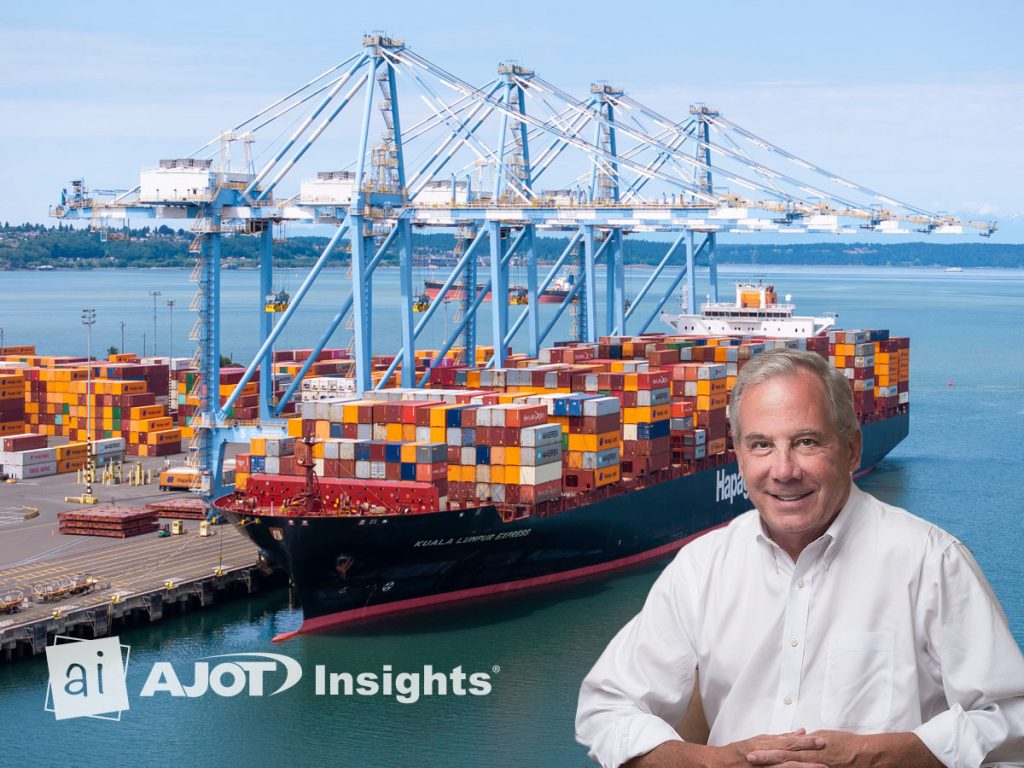
John McCown, maritime analyst and publisher of the McCown Report, says the Trump administration’s stated goal of instituting a waiver of the Jones Act to allow foreign flag carriers to transport petroleum products between US ports so as to reduce high gasoline prices has not succeeded.
McCown spoke to the Propeller Club of Northern California (PCNC) on July 28th where he said that the Trump administration instituted and extended the waiver to ostensibly bring in lower cost foreign flag tankers to reduce gasoline prices that had spiked as a result of the War with Iran: “The President’s press secretary said this (Jones Act Waiver) was to relieve short term problems in the oil market. Well…the best analysis that I highlighted… concluded that the total cost savings from lower Jones Act movements of gasoline would be something like 2/100 of a cent of a gallon… So, it’s not achieving the purpose.”
Profits and Profiteering
The result of the waiver has been profiteering: “Most of these voyages… involve petroleum… The other thing that they’re not talking about is all of the pricing on these. Most of them are actually at or above the rates the Jones Act vessels get. In fact, some of them materially above. And the reason for that goes back to why these voyages are occurring. We had a major dislocation in the oil market (caused by the closure of the Strait of Hormuz) that created arbitrage opportunities. For instance, California’s price went up something like $1.50 a gallon versus a nationwide average of $1.10. That led to an arbitrage situation. You have trading companies that are indifferent to how much they pay for freight. But if they can lock in something and they could pay a million dollars a day to rent a tanker, if that works out to a profit, they’re going to do that. That has nothing to do with a real underlying market. So, they’re not achieving the purpose they were set out to do. They are also, however, hindering initiatives that are underway and long-term goals.”
McCown said the Trump administration’s lifting of Jones Act restrictions on foreign flag vessel shipments between US ports is not consistent with the administration’s support for the US maritime industry’s revival: “There are just a lot of baffling things. Commodities that are moving. For instance, there have been three voyages by Chinese flag ships by COSCO, moving asphalt to Maryland. That’s hardly a national security issue…”
This is particularly true for the Trump administration initiatives to support new shipbuilding in the United States: “things like the (Hanwha) Korean shipyard in Philadelphia, a fascinating company and Saronic Technologies, what they’re doing and actually building vessels and eventually hope to be building commercial vessels proposed for Brownsville, Texas. Those are all initiatives that are… fundamentally based on the rules that were in play when they made those investments. So, there’s a fundamental unfairness to that. And it also is inconsistent with the long- term goals that have been articulated by this administration.”
McCown added, “What’s amazing to me is there probably hasn’t been any administration that has had so many initiatives and stated plans and actual actions that are beneficial to the maritime sector, from shipbuilding to others across the board and… in the middle of that to kind of take a knife to the heart of the merchant marine is just really baffling. I mean, again, where you have Chinese ships and Russian ships going into US ports in the interior, when the same administration wanted to put in place these US Trade Representative (USTR) fees on Chinese ships, it would be up to $10 million per port call just for a Chinese ship visiting and then to turn around and say, well, we don’t want Chinese built ships, but it’s fine with the COSCO (China Ocean Shipping Company) ship to have three voyages to move asphalt. It’s just nonsensical.”